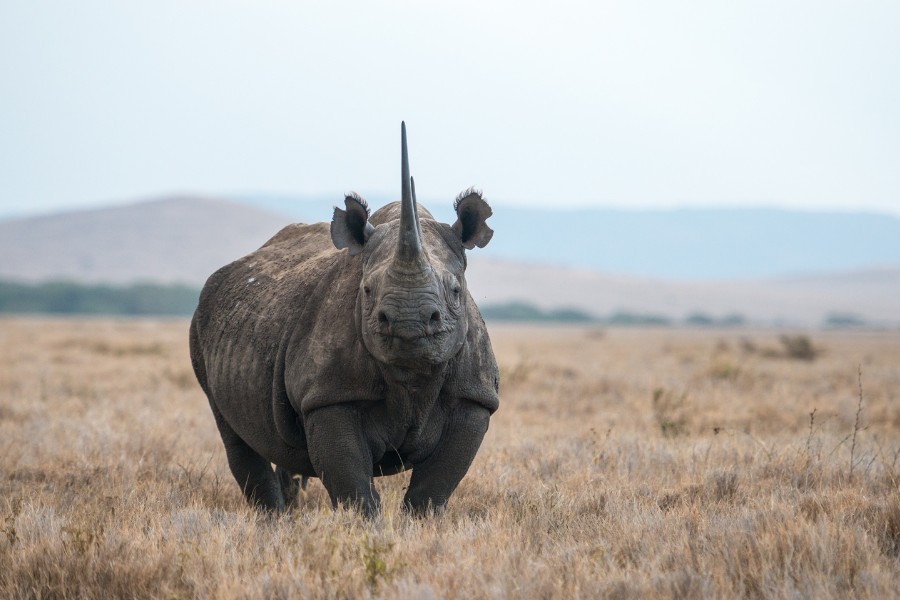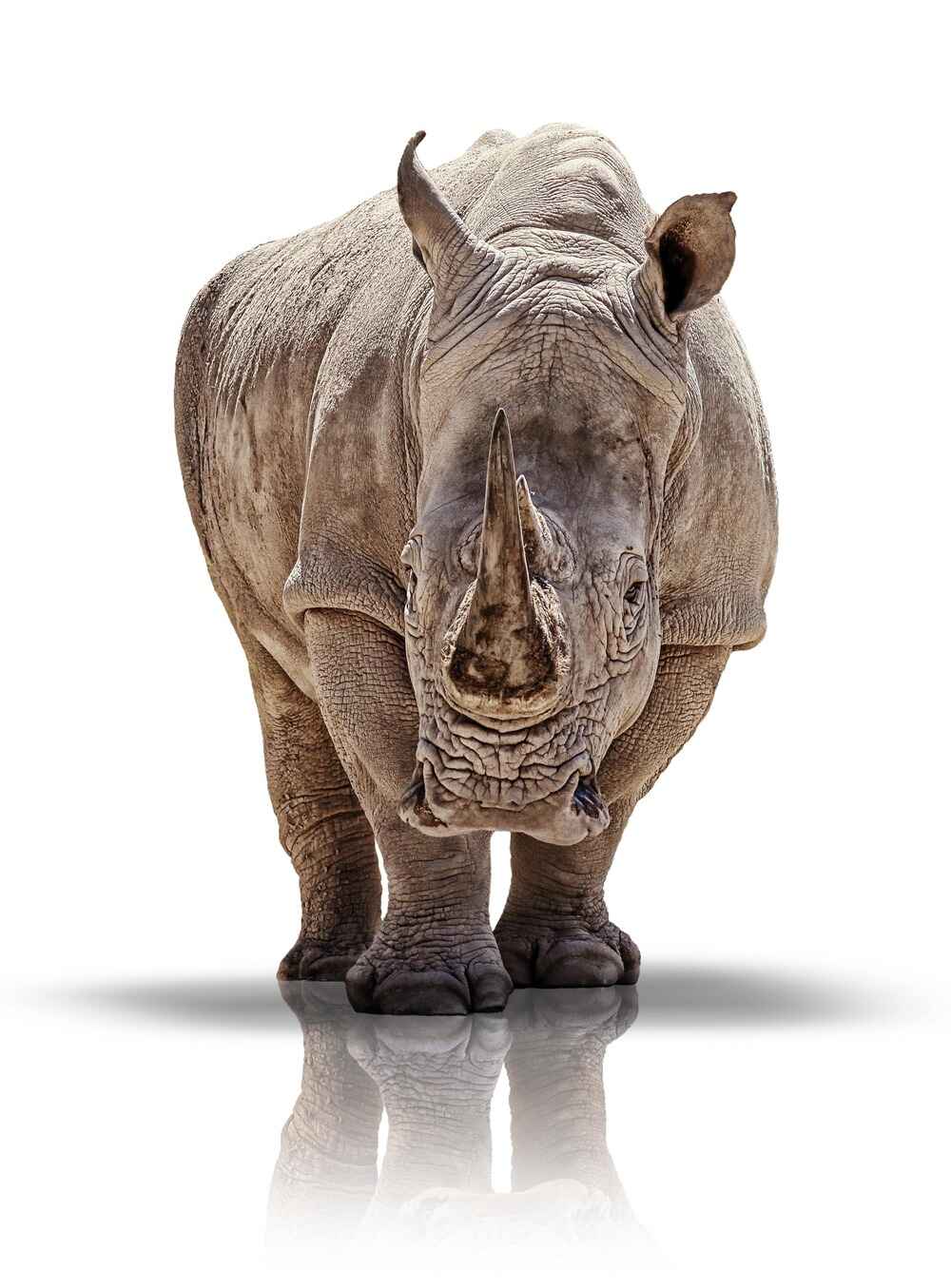

At first glance, a northern white rhino and a southern white rhino may look much the same. Both are large, grey, wide-mouthed grazers with two horns and the characteristic shape that gives the white rhino its other common name: the square-lipped rhinoceros.
But they are not simply two populations living at opposite ends of Africa. The northern and southern white rhinos are genetically and physically distinct, with separate evolutionary histories and dramatically different conservation stories.
Today, that difference is particularly significant. While thousands of southern white rhinos remain in the wild, only two northern white rhinos are still alive.
What is a White Rhino?
The white rhino (Ceratotherium simum) is Africa’s largest rhino species and one of the world’s largest land mammals. Its broad, flat mouth is adapted for grazing on grasses, allowing it to feed with its head lowered close to the ground.
Despite the name, white rhinos are not actually white. Their skin is grey, much like that of other rhino species. The name is generally linked to the Afrikaans word wyd, meaning “wide”, referring to the animal’s broad mouth.
There are two recognised forms of white rhino:
- Southern white rhino (Ceratotherium simum simum)
- Northern white rhino (Ceratotherium simum cottoni)
Although they share a common ancestor, genetic research shows that the two populations have been separated for more than a million years. They also differ in skull structure, teeth, body proportions and several external characteristics.

The Southern White Rhino
The southern white rhino is the more numerous of the two and is primarily associated with southern Africa. South Africa is home to the largest population, with other important populations in Namibia, Zimbabwe, Kenya and several other countries.
Its conservation history is remarkable.
By the end of the 19th century, southern white rhinos had been pushed to the brink of extinction. Fewer than 100 were believed to remain when a small population was discovered in South Africa in 1895. Intensive protection and conservation efforts, particularly in what is now Hluhluwe-iMfolozi Park, helped the population recover.
That recovery makes the southern white rhino an important example of what long-term conservation can achieve.
However, its story is far from over. The latest figures put the wild southern white rhino population at approximately 15,752 animals, following an 11.2% decline in 2024, largely driven by poaching losses in South Africa.
The southern white rhino is therefore still under pressure, even though its population is measured in thousands rather than single digits.
The Northern White Rhino
The northern white rhino once occupied parts of Central and East Africa, including areas of Uganda, South Sudan, the Central African Republic and the Democratic Republic of the Congo.
For much of the 20th century, the population was still substantial. Then decades of habitat loss and poaching caused numbers to collapse.
The northern white rhino’s last known wild stronghold was Garamba National Park in the Democratic Republic of the Congo. By the mid-2000s, only a handful of animals remained there, and the subspecies is now considered possibly extinct in the wild.
The situation reached a critical point in March 2018, when Sudan, the last known male northern white rhino, died at Ol Pejeta Conservancy in Kenya.
His death left just two northern white rhinos alive anywhere in the world: Najin and her daughter, Fatu. Both are female. Neither can reproduce naturally, meaning that the northern white rhino can no longer recover through conventional breeding.

Northern white rhino vs southern white rhino: the key differences
Although they belong to the same white rhino lineage, there are several differences between the two.
Where they lived
The biggest difference is their historical range.
Northern white rhinos were found in parts of Central and East Africa, particularly in countries such as Uganda, South Sudan and the Democratic Republic of the Congo.
Southern white rhinos are associated primarily with southern Africa, with the largest remaining populations in South Africa, Namibia and Zimbabwe.
Their ranges were separated geographically, allowing the two populations to evolve independently for a very long period.
Size and body shape
Southern white rhinos tend to be larger and heavier than northern white rhinos.
Northern white rhinos also appear relatively higher-legged and less heavily built, while southern white rhinos tend to have a longer-bodied appearance. Scientific comparisons have identified differences in body measurements, skull structure and skeletal proportions.
Hair and skin folds
There are also subtle differences in their appearance.
Southern white rhinos generally have more pronounced skin folds and can have more visible body hair, while northern white rhinos tend to have less pronounced folds in areas such as around the eyes and elbows.
These differences are subtle, however, and both forms retain the unmistakable broad mouth, large head and two-horned profile of the white rhino.
Teeth and skull structure
Some of the clearest differences are not visible from a distance.
Research has identified differences in the skull, teeth and cranial anatomy of northern and southern white rhinos. Genetic studies have also confirmed that the two populations are distinct.
This is one reason the northern white rhino is important to conserve in its own right. Saving the southern white rhino does not mean that the genetic heritage of the northern white rhino is automatically preserved.
Two Very Different Conservation Stories
Perhaps the most important difference between the two is not physical at all. It is their conservation status. The southern white rhino demonstrates that conservation can work. After being reduced to fewer than 100 animals, the population recovered into the thousands through protection, habitat management, breeding and reintroduction programmes.
The northern white rhino tells the opposite story. Its decline happened so dramatically that conservation efforts were unable to prevent the loss of the wild population. Today, there are only two known individuals left.
This is why the northern white rhino is described as functionally extinct. The animals are still alive, but natural reproduction is no longer possible.
Can the Northern White Rhino be Saved?
The answer now depends on science as much as traditional conservation.
With no surviving male, researchers cannot simply place Najin and Fatu together with a breeding partner. Instead, the international BioRescue consortium is working with preserved northern white rhino genetic material and assisted reproductive technologies.
Fatu has undergone procedures to collect eggs, which have been fertilised using stored sperm from northern white rhino males that died before the population reached its current crisis point. The long-term goal is to use assisted reproduction, embryo transfer and stem-cell technologies to produce northern white rhino calves. Southern white rhinos can potentially serve as surrogate mothers for these embryos.
It is an extraordinary conservation effort, but it is not a guaranteed solution. The northern white rhino remains on the edge of extinction, and every step towards producing a new generation carries significant scientific, logistical and ethical challenges.
Why the Northern White Rhino Matters
The story of the northern white rhino is bigger than the survival of two animals. Rhinos are important grazers and browsers that influence vegetation and help shape the ecosystems in which they live. Their decline is also a reminder of how quickly wildlife populations can disappear when habitat loss, instability and illegal wildlife trade combine.
The northern white rhino shows why conservation cannot wait until a population reaches its final handful of individuals.
The southern white rhino’s recovery proves that populations can return from the brink when there is sustained protection and investment in conservation. The northern white rhino shows what can happen when those efforts come too late.
The two white rhinos may share a name, a family tree and many of the same physical characteristics. Their futures, however, could hardly be more different.
White Rhinos VS Black Rhinos

White and black rhinos are Africa’s two native rhino species, but they differ in appearance, behaviour and diet. White rhinos are generally larger and have wide, flat lips adapted for grazing on grass, while black rhinos are smaller and have a pointed, prehensile upper lip suited to browsing on leaves, shoots and branches. Despite their names, both species are actually grey in colour.
FAQ: Frequently Asked Questions About White Rhinos
Are northern and southern white rhinos the same species?
They are two distinct subspecies of the white rhino: the northern white rhino (Ceratotherium simum cottoni) and southern white rhino (Ceratotherium simum simum).
How many northern white rhinos are left?
Only two northern white rhinos remain: Najin and her daughter Fatu. Both are female and live under protection in Kenya.
What is the main difference between northern and southern white rhinos?
They differ in their historical ranges, genetics and some physical characteristics. The most significant difference today is their conservation status: southern white rhinos still number in the thousands, while only two northern white rhinos survive.
Are northern white rhinos extinct?
The northern white rhino is considered functionally extinct. Only two females remain, and there is no surviving male, meaning natural reproduction is no longer possible.
Are white rhinos endagered?
The northern white rhino is functionally extinct and the southern white rhino remains threatened despite its much larger population.
How big are white rhinos?
White rhinos are the biggest among the five species, with adults weighing over 2,000kg (4,400lbs).
How long is white rhino pregnant?
A white rhino’s gestation period is around 16 months and females typically give birth to one calf.
How long do rhinos live?
White rhinos can live for around 40 to 50 years in the wild, although lifespan varies depending on conditions and individual health.
How fast can a white rhino run?
Despite their size, white rhinos can run at speeds of around 40 km/h over short distances.
What is a group of rhinos called?
A group of rhinos is commonly called a crash. White rhinos are generally more social than black rhinos and may be found in small groups, particularly females and their calves.